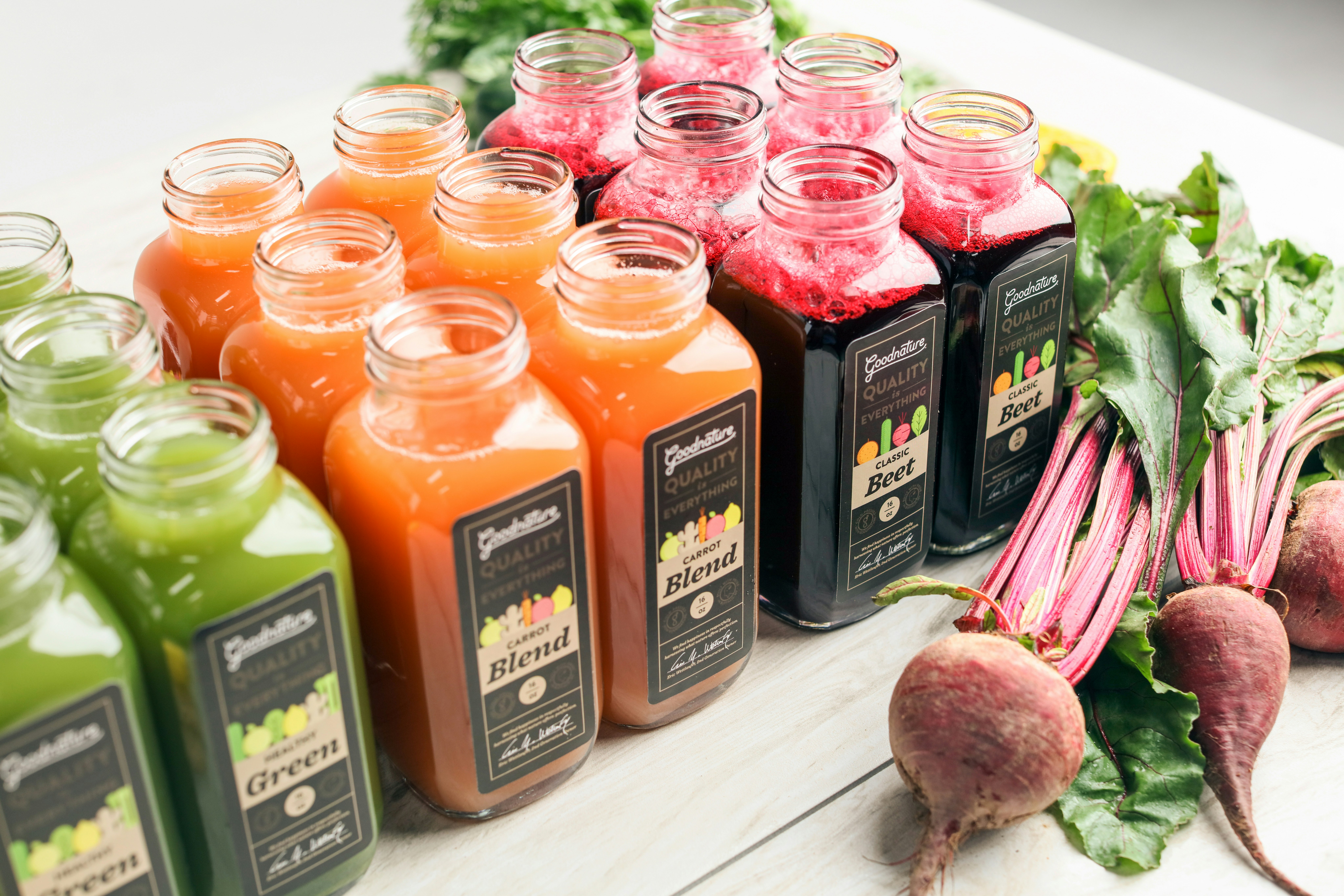
When searching for a high volume juicer, there are several important things to consider. You will want to to consider hourly production capacity (bottles or gallons per hour), yield, and labor time spent at the juicer.
Whether shopping for a small countertop machine, or a large industrial juicer, it's important to understand how to achieve maximum volume from your juicer.
Questions about juicing?
Ask Goodnature and get an answer in seconds.
What actually counts as a "high-volume" juicer?
The phrase gets thrown around loosely. In practice, a high-volume juicer is one that can sustain production of enough finished juice to keep a retail bar or a wholesale juice brand supplied without becoming the bottleneck in the day. The bottleneck should be prepping at bottling juice, not the juicer itself.
A rough working definition:
- Countertop / small commercial: capable of running a few gallons per hour of finished juice, reliably, without overheating or requiring a mid-shift teardown. Must be able to operate continuously without needing a resting period.
- Full-size commercial press: 20+ gallons per hour of finished juice, built to withstand the rigorous demands of a juice-first business. Ideal for high volume juice bars, grocery stores, or local wholesale companies.
- Industrial: Large, made-to-order installation machines that usually sit within a larger factory layout. Think cider producers and national juice brands.
Masticating vs Cold Press Yield
Achieving High Yield
Yield is measured by the percentage of juice you end up with compared to the weight of produce that goes into the juicer. For example, if you start the day with 10 lbs of produce, and end with 8 lbs of juice, that is an 80% yield. Certain juicing technologies offer much higher yield than other technologies.
Next I will compare the two most popular juicing technologies:
1. Masticating Juicer
Masticating juicers are also referred to as "slow juicers", "auger" juicers, or within the past few years they have the adopted the term "cold press juicer" (although it's incorrect, since it doesn't actually contain a press). Popular brands include Nama and Kuvings.
Masticating juicers, although very popular, actually leave the pulp quite wet and achieve lower yield in most recipes than a true juice press / cold press juicer.
2. Juice Press
Sometimes referred to as "hydraulic juicer" or "two-stage juicer", this is the only true cold press juicer, as it is the technology that actually contains a press. The term "cold press juicer" was first used in the 1920's by Dr. Norman Walker to describe the two-stage juicing process of the Norwalk juicer (no longer manufactured).
The way it works is that the produce is first chopped up in the grinder to open up the plant cells, then a slow moving press slowly extracts juice under thousands of pounds of force. This process gives the highest yield, most nutrient-dense juice, with the longest shelf life, and minimal oxidation. This is why it's the chosen technology for nearly all commercial cold-pressed juice companies, both small and large.
Labor Time
When considering a high volume juicer, labor time is an important factor. There are a few different places labor time shows up:
- Prep time - how small do you have to cut the produce?
This, again, is where a real juice press shows an advantage over masticating juicers. It's not just about the size of the chute - it's also the technology of the juicer. A Masticating juicer requires cutting some items very small like ginger and celery, because the fibers can jam the juicer. A Goodnature juice press can be fed in whole stalks of celery and full ginger roots, saving a lot of prep time. Our larger commercial model, the X-1 can actually be fed entire pineapples without cutting or peeling them. Talk about labor savings! - Time at the juicer
Whether you have to stand at the juicer the whole time or can walk away while it's working is a major element in calculating labor time. With Goodnature juice presses, once you finish grinding the produce, you can walk away while the press is extracting the juice. The press cycle is approximately 65% of the juicing time, meaning you only need to spend about 35% of the juicing time at the juicer. During the press cycle, you can be getting the next batch ready, bottling juice, or starting cleanup. - Time to switch between recipes
Masticating juicers often require pulling the mesh screen out and washing it off, since it gets clogged with fibers from the produce. On a Goodnature juicer, the pulp is contained in a press bag which can simply be swapped out between recipes quickly and easily. The grinder itself holds very little residue, and usually doesn't require cleaning. It is a blade, not a mesh screen. However, it's important think about the order of recipes in this case. For example, if you go from beet juice to green juice, there may be some red color that transfers. That's why we recommend going from the light color juices to the dark ones. - Cleaning time
At the end of the session, how long it takes to do a full cleaning is important. The parts of Goodnature Hummingbird can be quickly taken off the juicer and rinsed out, and placed in a dishwasher or washed by hand. There is no find mesh screen to scrub - no tooth brush needed!
These reasons and more are why a juice press is the best high volume juicer. Here are the recommended models for each type of business:
Recommend High Volume Juicers
Depending on your use case, here are the recommendations for high volume cold-press juicers:
- Juice bar startups or high-volume juicing homes: Goodnature Hummingbird is the best compact juicer for high volume. Reasonably priced, fully commercial certified. Comes in two sizes. Easy to use, easy to clean, a perfect entry into high volume juicing.
- High volume juice bars, grocery stores, or locally distributed wholesale juice: Goodnature X-1. If you need to make hundreds of bottles of juice per day, the X-1 is a total game changer. Minimal prep, high hourly throughput (20-30 gallons), and almost no prep needed for most ingredients.
- Regional or national brands: Goodnature X-6 or Goodnature Maximizer. These are for serious wholesale juice companies producing thousands of gallons of juice. Think national cold-press brands like Suja, or apple cider producers like Beak and Skiff 1911.
Thanks for reading, if you need any assistance the Goodnature team is standing by. Simply drop a contact request and one of our knowledgeable juicing expert will reach out!
Join Our Mailing List
Join our mailing list to get new juicing articles and recipes sent directly to your inbox.

About The Author
Charlie Wettlaufer
President and CMO - Goodnature Host - Cold Pressed Truth and Goodnature Radio Creator - JuiceCon
I’ve been around juicing all my life. My Dad built his first hydraulic juice press in 1976 and founded the company Goodnature Products, Inc. I have incredible memories of having “cider parties” when we would invite all the people in our rural neighborhood over to make apple juice. To this day, when I taste apple juice made on a Goodnature press, a rush of nostalgia runs through my body. I pride myself on guiding our clients into the world of cold-pressed juice and showing them how much fun this industry can be. I love talking business, technology, and marketing. My mission is to carry on my Dad's goal - one day make Goodnature a house-hold name.
Comment